> For the complete documentation index, see [llms.txt](https://docs.flycode.com/docs/llms.txt). Markdown versions of documentation pages are available by appending `.md` to page URLs; this page is available as [Markdown](https://docs.flycode.com/docs/es/introduction/how-teams-handle-failed-payments-before-flycode.md).
# Cómo gestionan los equipos los pagos fallidos antes de FlyCode
Por qué los reintentos fijos y el dunning centrado primero en email rinden por debajo de lo esperado: los bancos y las redes de tarjetas califican cada transacción de forma distinta, así que una sola regla para cada fallo hace perder ingresos.
Los equipos están intentando gestionarlo mediante:
(1) basándose en la recuperación básica de su proveedor de pagos (como la recuperación inteligente básica de Stripe);
(2) usando estrategias de fuerza bruta o de reintento a intervalos fijos, un enfoque heredado que en última instancia reduce las tasas de éxito de los reintentos y aumenta la deserción de clientes;
(3) enviando demasiados o muy pocos correos electrónicos a los clientes (contacte a su banco..).
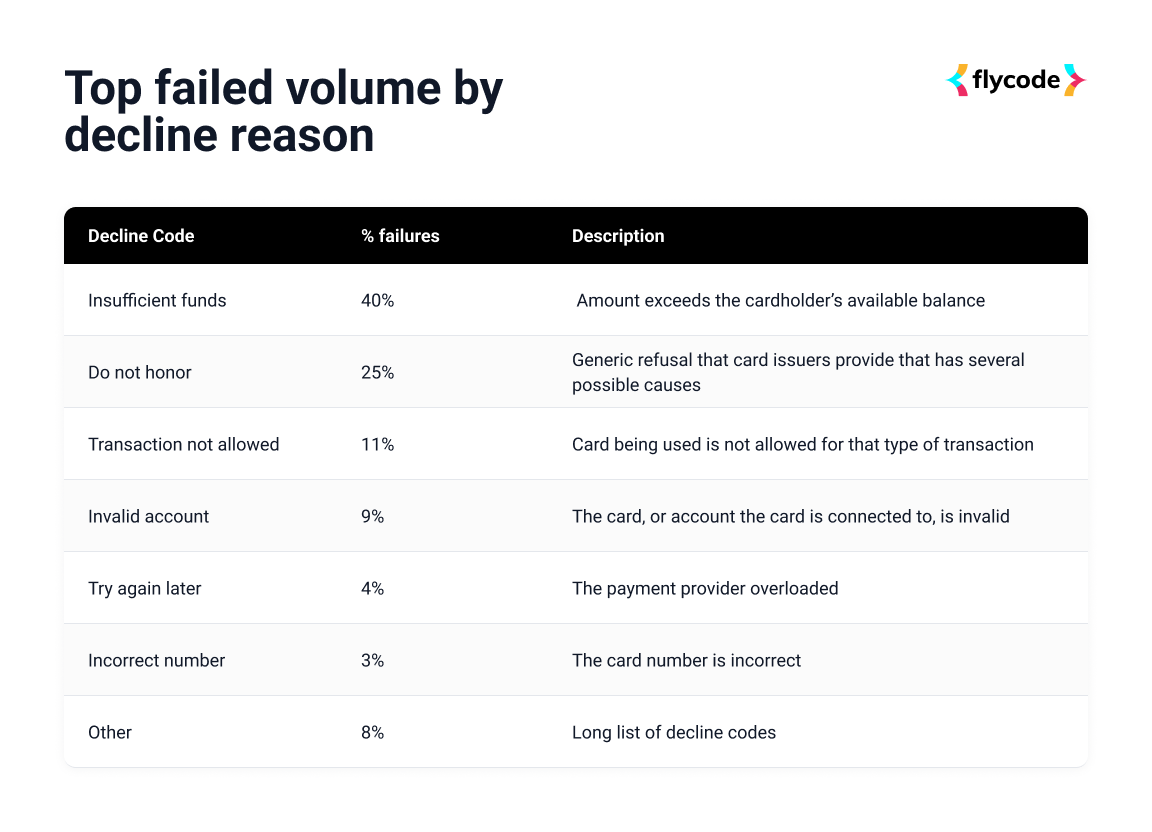
Uno de los mayores desafíos es que los proveedores de pagos, los bancos emisores y las redes de tarjetas clasifican los errores en distintas categorías y tienen sus propias reglas de riesgo, lo que añade complejidad y hace que muchos errores se agrupen, como ‘No autorizar’.
## Relacionado
* [Gestión de pagos fallidos](https://help.flycode.com/handling-failed-payments) en el Centro de ayuda
* [Guía de gestión de recobros 2026](https://docs.flycode.com/docs/dunning-management-2026-guide)
* [Comparativa de plataformas de recuperación de pagos 2026](https://docs.flycode.com/docs/read-more/payment-recovery-platforms-compared-2026)
---
# Agent Instructions
This documentation is published with GitBook. GitBook is the documentation platform designed so that both humans and AI agents can read, navigate, and reason over technical content effectively. Learn more at gitbook.com.
## Querying This Documentation
If you need additional information that is not directly available in this page, you can query the documentation by asking a question.
Perform an HTTP GET request on the following URL with the `ask` and `goal` query parameters:
```
GET https://docs.flycode.com/docs/es/introduction/how-teams-handle-failed-payments-before-flycode.md?ask=&goal=
```
`ask` is the immediate question: it should be specific, self-contained, and written in natural language.
`goal` is what the user is ultimately trying to achieve, the reason they need the answer. Sharing it helps GitBook give you a better, more relevant answer. A goal is most helpful when it describes the outcome the user wants rather than restating the question. For example, with `ask=how do I create an API token`, a goal like `automate deployments from our CI pipeline` lets GitBook tailor the answer to that use case.
The response will contain a direct answer to the question and relevant excerpts and sources from the documentation.
Use this mechanism when the answer is not explicitly present in the current page, you need clarification or additional context, or you want to retrieve related documentation sections.